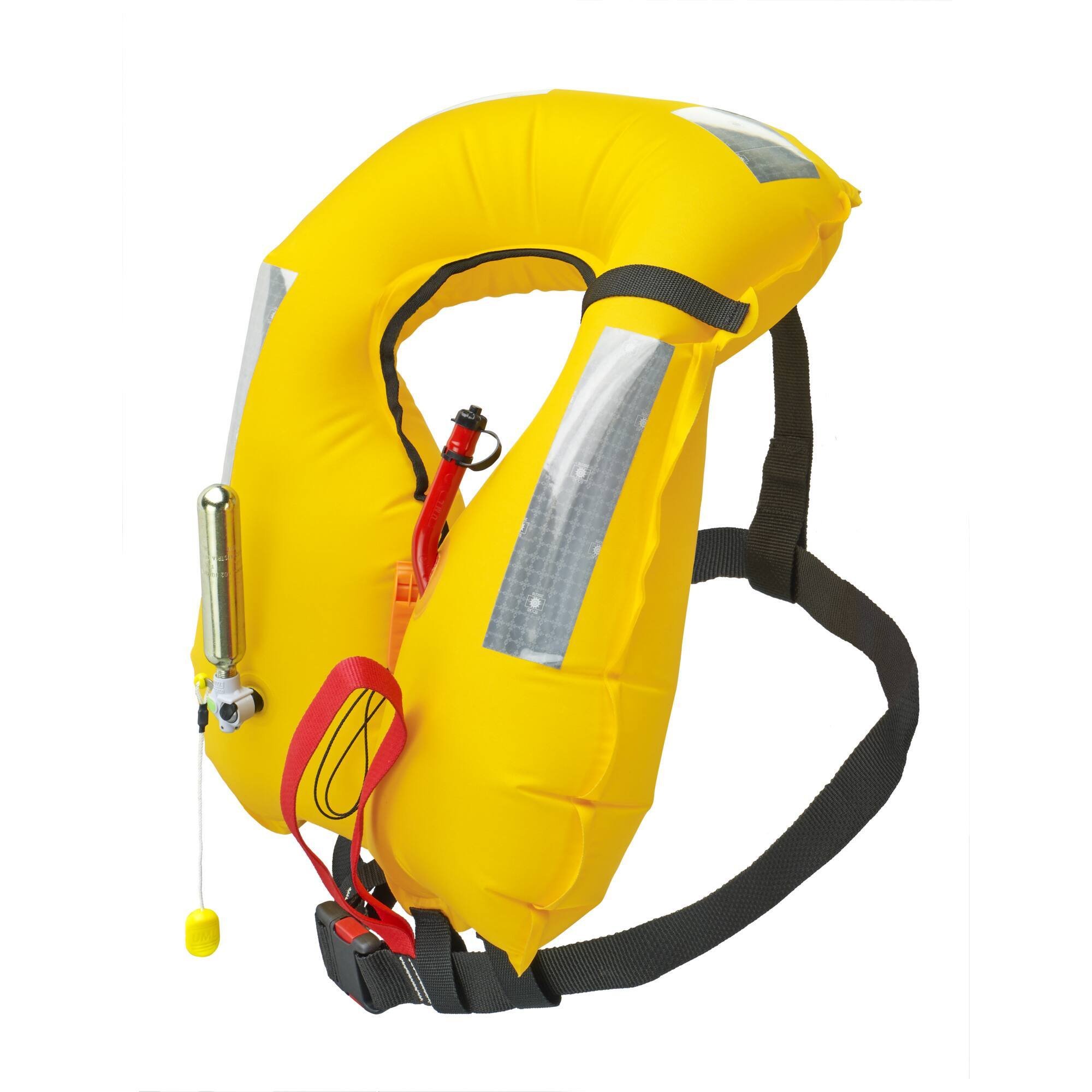
Why do inflatable life jackets require regular maintenance?
An inflatable life jacket is compact, comfortable and modern – that is why it has become the standard for most sailors in Latvia and Europe. However, unlike a classic foam life jacket, which has practically no maintenance requirements, an inflatable life jacket is a mechanical device with expiration dates, sensors and a compressed gas cylinder. If it is not taken care of, it may not work at a critical moment – and for some categories of vessels, Latvian legislation no longer leaves it as a recommendation, but makes it a mandatory requirement with documentary evidence.
Latvian legal framework depending on the vessel category
In Latvia, life jacket requirements differ depending on where the vessel or watercraft is registered and how it is used. There are three fundamentally different regimes.
Recreational vessels (CSDD registered watercraft)
The Cabinet of Ministers' Regulations No. 92 "Regulations on the Traffic of Vessels in Inland Waters" (likumi.lv ID 280190) and the Cabinet of Ministers' Regulations on the Safety of Recreational Vessels (likumi.lv ID 173015). They stipulate that the number of life jackets must correspond to the number of people on board, children under 12 years of age must wear a life jacket during transportation, and persons traveling by jet ski or sailing with a surfboard must wear a life jacket at all times.
In this category, the law does not impose a formal obligation to present service documents - but requires that the life jacket be in working order. Responsibility for the technical condition lies with the owner.
Commercial vessels and yachts registered in the Latvian Ship Register
Here the situation is fundamentally different. Cabinet Regulations No. 49 "Regulations on the Safety of Vessels" (likumi.lv ID 171626) apply to all vessels registered in the Latvian Ship Register that are intended for commercial activities (including passenger transportation, charter, training), as well as registered yachts.
Paragraph 29 of these regulations clearly states:
"The shipowner shall present the ship for annual inspection every year during a six-month period starting three months before the expiry date of the seaworthiness certificate and ending three months after that date. During the inspection, he shall ensure that (..) the mandatory inspections of life-saving appliances and fire-fighting equipment have been carried out in a timely manner."
This means the following: in order for a ship to have its seaworthiness certificate extended in the Latvian Ship Register, the lifejackets must have valid, documented maintenance. If, during the annual inspection, an inspector of the Maritime Safety Inspectorate (KDI) of the Maritime Administration of Latvia determines that the inflatable lifejackets do not have service documents to present or the deadline has passed, the ship's certificate shall not be extended. In practice, this means suspending the operation of the ship until the requirements are met.
This annual requirement is the reason why owners of commercial vessels and registered yachts cannot rely on self-inspection – the service must be carried out at an authorised service station, which will issue a document with the next service due date.
International requirements and SOLAS
Larger commercial vessels are additionally subject to the International Convention for the Safety of Life at Sea (SOLAS) 1974 and the Life-Saving Appliances Code (LSA Code), which stipulate even stricter service intervals and require the use of only SOLAS-certified life jackets with the appropriate marking.
EN ISO 12402-3 – what is hidden behind the label
Most quality inflatable life jackets for adults comply with the EN ISO 12402-3 standard – the international standard for personal flotation devices with a buoyancy level of 150 N. This is the minimum for sailing on the high seas and near the coast.
The standard requires that a fully inflated life jacket is capable of turning an unconscious person into a position with the mouth and nose above the water, and of holding a fully clothed person in this position without active participation on his part. The standard clearly states that the amount of regular inspection and maintenance is a decisive factor in ensuring the performance of a particular flotation device. In other words, the certificate on the sticker guarantees performance only as long as the life jacket is in good condition.
Compliance with EN ISO 12402-3 is also checked for the inflation mechanism: the gas cylinder must remain firmly fixed, the status indicators must show valid activation, and the contact between the cylinder and the inflation system must remain intact.
Two main activation mechanisms: Hammar and UML
Inflatable life jackets on the Latvian market are basically offered with two types of activation mechanisms, and each requires a slightly different approach to maintenance.
Hydrostatic Hammar MA1 vests
Hammar MA1 is a second-generation hydrostatic activator from the Swedish manufacturer CM Hammar, certified according to ISO standards. It works on the principle of water pressure - the mechanism is activated only when the vest is approximately 10 cm underwater. This means that rain, splashes or moisture in the warehouse do not trigger the mechanism - activation occurs only in the event of real immersion.
The advantage of the Hammar MA1 is its sealed design: the gas cylinder is hermetically attached to the puncture point and is located inside the vest, so it cannot be accidentally unscrewed or damaged. The expiration date of the inflation cap is 5 years - thus, service of the mechanism part is not required during this period, but it should still be replaced after the expiration date or after each activation.
This type of vest is suitable for sailing in the open sea, when conditions are wet or extreme and accidental activation of the UML would be troublesome. An example from the boatshop.lv range – Plastimo Pilot 165N with Hammar hydrostatic mechanism.
UML automatic life jackets
The UML (United Moulders Limited) system uses a water-soluble paper capsule (bobbin), which, when wet, dissolves and releases a spring, piercing a CO₂ canister. This mechanism activates quickly and reliably – the life jacket inflates within seconds of contact with water.
The UML activator has its own characteristics that should be remembered:
The shelf life of a paper capsule is usually about 3 years (the date is printed on the gray mechanism body).
High humidity in the warehouse or heavy rain on deck can theoretically cause premature activation.
Manufacturers recommend replacing the capsule at least 6 months before the specified expiration date.
The advantages of the UML system are simplicity, lower weight and very wide availability of spare kits in any port in the world. An example from the boatshop.lv range – Plastimo Neo 165N with UML automatic mechanism.
How often to perform maintenance?
For commercial vessels and registered yachts, the answer is clear – once a year, linked to the annual inspection, with documentary evidence issued by an authorized service station. Without this document, the annual inspection will not be successfully completed.
For owners of recreational boats, the common recommendation of the largest European manufacturers – including Plastimo, Secumar and other members of the European Federation of Lifesaving Equipment (FSR) – is a professional service inspection at least once every two years. In between services, the owner can perform visual checks himself before each season: look at the color of the indicators (green = in working order, red = need to be replaced), check the weight of the CO₂ cylinder against the value printed on it, make sure that the seams and straps are not damaged, and perform an oral inflation test for 12–24 hours to make sure that the bladder holds pressure.
Professional service includes what cannot be done at home:
Opening of the inner bladder, washing and detailed inspection for delamination and microcracks.
Leak test of seams and heat-welded joints.
Calibration of the activation mechanism and inspection of sensors.
Coordinated replacement of the CO₂ cylinder, capsule and indicator according to the specifications of the original spare parts.
Affixing of a service stamp or sticker documenting the actions taken and the next service due date - this is exactly what the KDI inspector will request during the annual inspection.
How long does an inflatable life jacket last?
The European Federation of Lifesaving Equipment (FSR) and all its members, including Plastimo, have agreed on a common recommendation: the maximum service life of an inflatable life jacket is 10 years from the date of manufacture, if the prescribed service interval is observed. After 10 years, the vest can be used for up to 14 more years, but only if it is serviced annually by the manufacturer or a center authorized by the manufacturer.
This limit is not arbitrary. After ten years, the fabric and bladder materials can begin to delaminate, which causes porosity and leakage. UV radiation, salt water, humidity and temperature fluctuations also affect the strength of the seams and the reliability of the mechanical parts over time. After the maximum period, the vest must be taken out of service regardless of its external condition.
For foam vests, this period is usually similar – about 10 years – but without mandatory service procedures, since they do not have mechanical components.
boatshop.lv – official Plastimo service station in Latvia
boatshop.lv is an official Plastimo authorized service station, which means that our specialists have received manufacturer training and work with original spare parts and calibration tools. This is especially important for owners of commercial vessels and registered yachts – only a service document issued by an authorized service station is recognized by the Maritime Safety Inspectorate of the Maritime Administration of Latvia as evidence of compliance with the requirements of Cabinet Regulation No. 49.
When servicing with us, you receive:
A full inspection according to the Plastimo factory protocol.
Original spare parts (CO₂ cylinders, UML capsules, Hammar MA1 kits).
A service note and a document with the date of the next scheduled service, valid for presentation to the KDI inspection.
A consultation on the appropriate type of life jacket for your sailing region and application.
A practical recommendation
If your vessel is registered in the Latvian Ship Register – a commercial vessel or a yacht – plan life jacket maintenance before the annual inspection. Without a valid service document, the certificate will not be renewed. For recreational boat owners, the situation is less formal, but no less important: if your inflatable life jacket has not seen a service center in the last two years, now is the right time to bring it in before the new season.
If the life jacket is already 10 years old or more and has not been inspected by the manufacturer, the best decision is to replace it with a new one. A life jacket is a category where saving money at the expense of maintenance or extending its life is out of place – it is one of the few pieces of equipment on board whose job is to work at exactly the one time when other solutions no longer work.
For consultation and service request, contact boatshop.lv – we will help you find out the type of your jacket, the brand of the mechanism and draw up a maintenance plan that meets both the manufacturer's requirements and the requirements of Latvian regulatory acts.