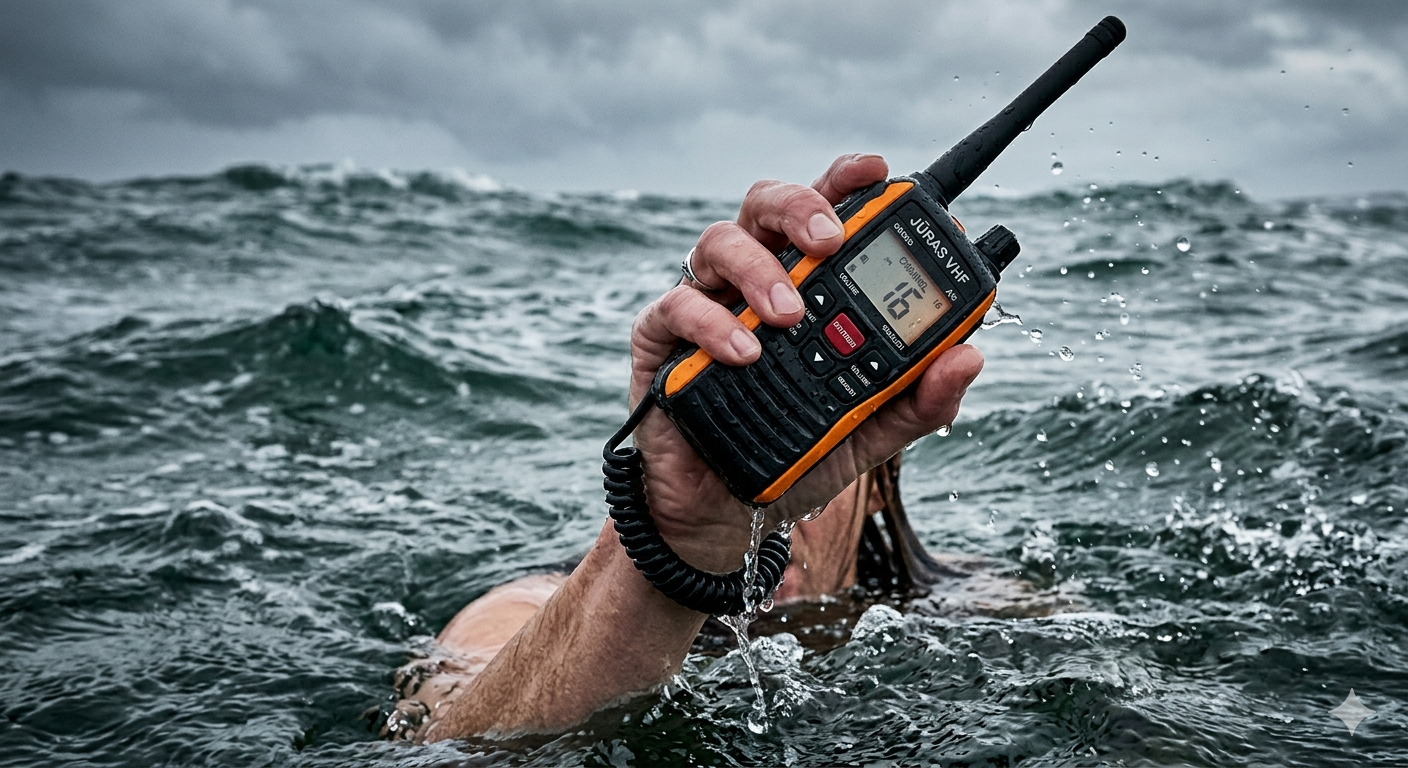
Why a marine radio is necessary on a boat and how to choose one
A marine radio, or VHF (very high frequency) radio, is one of the few pieces of equipment on a boat that can truly save lives. Unlike a cell phone, which works only within the carrier’s coverage area and connects only one-on-one, a marine radio transmits on an open channel that can be heard simultaneously by all nearby vessels and shore-based services. On the Baltic Sea, this is the difference between a situation where the entire region is aware of your distress and one where no one knows about it.
Latvian legal framework – when a radio is mandatory
In Latvia, the use of ship radio equipment is regulated by several regulatory acts, which are available at likumi.lv.
Permits and MMSI assignment
To legally use a VHF radio on a vessel, it must be registered. Permits are issued and MMSI numbers are assigned by the State Agency “Electronic Communications” – permits are requested by the vessel owner or operator based on data from the Latvian Maritime Administration or the CSDD. Use without a valid permit and an assigned call sign constitutes a violation of radio communication regulations.
Specific equipment requirements – Cabinet of Ministers Regulation No. 30
The main regulatory document is Cabinet of Ministers Regulation No. 30 "Regulations on the Use and Maintenance of Ship Radio and Navigation Equipment" (likumi.lv ID 279823). These regulations specify the required radio equipment depending on the ship type and the category of recreational craft.
Recreational vessel categories (defined in Cabinet of Ministers Regulation No. 27 on the Assessment of Conformity of Construction) correspond to the conditions for which the vessel is designed:
- Category A – ocean navigation
- Category B – offshore navigation
- Category C – coastal navigation
- Category D – sheltered waters (bays, harbors, lakes)
The mandatory radio equipment also varies depending on the category and size:
Category D recreational vessels with a hull length of 12 m or more, as well as all Category D vessels in port waters (Cabinet Regulation No. 30, Section 26) must be equipped with at least one portable, splash-proof VHF radio station capable of transmitting distress and safety signals on Channel 16.
Category C recreational vessels up to 24 m in length (Paragraph 24) must be equipped with a VHF radio with DSC capability on Channel 70 and at least one portable splash-proof VHF radio. A NAVTEX receiver and MF/HF radio equipment are also recommended.
Recreational vessels of Categories A and B up to 24 m in length (Section 23) must be equipped with significantly more extensive equipment: VHF with DSC, one or more portable radios (depending on the number of liferafts), MF/HF radio equipment or maritime satellite communication equipment, a NAVTEX receiver, and an emergency position-indicating radio beacon (EPIRB).
Recreational craft with a hull length exceeding 24 m must be equipped in accordance with the requirements for cargo ships, including the full scope of the GMDSS.
Commercial vessels and yachts registered in the Latvian Ship Register
Here, the requirements are formal and detailed. In addition to Cabinet Regulation No. 30, Cabinet Regulation No. 49 “Regulations on Vessel Safety” (likumi.lv ID 171626) also applies—radio equipment is inspected during the annual survey, and the certificate of seaworthiness will not be renewed without a fully operational and certified radio.
Radio equipment inspections are conducted at least once every three years following the initial inspection and may only be performed by a commercial entity certified by the Latvian Maritime Administration or a recognized classification society.
Operator’s Certificate
To use a VHF radio with DSC functionality, a Short Range Certificate (SRC) is required. In Latvia, this is issued after completing training and passing an exam. Without a certificate, the radio may only be used in a genuine emergency situation when a MAYDAY call is made—in which case anyone is authorized to do so.
What are DSC and MMSI?
These are two terms you hear every time modern marine radios are discussed, and they are often confused.
MMSI – Maritime Mobile Service Identity
MMSI (Maritime Mobile Service Identity) is a nine-digit number that uniquely identifies a ship or shore-based radio station. It is like a ship’s “phone number” in the digital maritime communication system—it allows DSC, AIS, and certain other types of equipment to identify a specific vessel.
The first three digits of the MMSI number are the so-called MID (Maritime Identification Digits)—the country code. For Latvia, this is 275. Thus, the MMSI of every Latvian-flagged vessel begins with 275. For example, the MRCC Riga DSC selective call number is 002750100—using this number, your radio can send a call directly to the Coast Guard Rescue Center.
In Latvia, MMSI numbers are assigned by VAS "Elektroniskie sakari" upon reviewing applications for ship station operating permits for vessels registered in Latvia. The MMSI must be requested directly in the country under whose flag the vessel sails – using another country’s MMSI is prohibited and may have serious consequences during a rescue operation.
DSC – Digital Selective Calling
DSC (Digital Selective Calling) is a digital signal protocol that operates in parallel with voice communication. In practice, this manifests as a “red button” on modern radios (usually under a protective cover). When pressed and held, the radio automatically transmits a digital call on channel 70 containing:
- The vessel’s MMSI number.
- The type of distress signal (fire, flooding, collision, man overboard, etc.).
- GPS coordinates (if the radio is connected to GPS).
- Time stamp.
This signal is received simultaneously by all nearby radios and coastal GMDSS stations. After a DSC call, the transmitter and all receivers automatically switch to Channel 16 for voice communication. This means that even if you are unable to speak or fail to say “MAYDAY” due to operator confusion, the distress signal and your location have already been transmitted.
The DSC function is now standard on all new marine radios and is mandatory within the GMDSS system.
EPIRB and PLB – emergency transmitters
In addition to a VHF radio, Cabinet Regulation No. 30 requires Category A and B recreational vessels (and commercial Category C vessels) to carry an emergency radio beacon, or EPIRB (Emergency Position-Indicating Radio Beacon).
An EPIRB is an emergency transmitter designed for installation on a vessel. It operates on the 406 MHz frequency and transmits a signal via the COSPAS-SARSAT satellite system, which covers the entire globe. Key features of an EPIRB:
- It floats freely and activates automatically if the vessel sinks.
- It can also be activated manually and moved to a life raft.
- Encoded with the specific vessel’s MMSI number—the signal immediately tells rescue services which vessel it is.
- Battery life is typically 10 years; periodic testing is mandatory.
A PLB (Personal Locator Beacon) is a personal location transmitter—a smaller and lighter equivalent of an EPIRB, designed for a single person. It can be carried in a pocket or attached to a life jacket. Latvian regulations do not require a PLB as mandatory ship equipment, but it is a very powerful addition:
- In a man-overboard scenario, the PLB transmits a signal even if the vessel is far away and the person does not have a handheld radio with them.
- On small vessels or boats where installing an EPIRB is impractical, a PLB can serve as the primary emergency transmitter (though it does not replace the EPIRB required by law for larger vessels).
- A PLB is registered to a specific person, not a vessel—it follows the person regardless of which vessel they are on.
In practice, on a serious sailing or fishing yacht, the optimal setup is an EPIRB on board plus a PLB for each crew member.
Classification of radios by type and power
The VHF radios available at Boatshop.lv can be divided into two main categories. The full range can be viewed in the VHF radios section.
Fixed (stationary) radios
These are installed at the helm, connected to the vessel’s electrical system (12 V) and an external antenna on the mast or roof. Key features:
- Power 25 W – the maximum power allowed by the ITU in the marine VHF band.
- Power can be reduced to 1 W – for close-range communication in port or marina, so as not to interfere with other channels.
- Built-in DSC function with a separate receiver on channel 70.
- NMEA 0183 or NMEA 2000 connection to GPS and chartplotters – allows coordinates to be automatically included in DSC calls.
- External antenna connection – the higher it is mounted, the greater the transmission range (VHF operates on a line-of-sight basis).
A fixed radio is the absolute minimum requirement on any vessel traveling beyond the coastline.
Handheld (portable) radios
These are compact, battery-powered devices that can be carried with you or used as a backup if the fixed radio fails (for example, in the event of a power outage or antenna damage). Key features:
- Power: 5–6 W – significantly lower than that of a fixed radio.
- Built-in antenna – fixed, suboptimal compared to the external antenna of a stationary radio.
- Water resistance – high-quality handheld radios meet the IPX7 or IPX8 standard; some models are floatable.
- Built-in GPS and DSC in the most modern models – full DSC functionality even in a handheld format.
- Battery with a separate charging station.
Many experienced sailors keep both options on board: a fixed radio as the primary means of communication and a handheld as a backup in the liferaft or pocket, in case they need to abandon ship.
Practical operating ranges
VHF radios operate on the line-of-sight principle—the signal travels in a straight line and is limited by the curvature of the Earth. This means that antenna height is more important than power. A fixed 25 W radio with an antenna at water level will perform worse than a handheld 5 W radio mounted on a tall mast.
Practical ranges under good conditions (open sea, no obstacles):
| Communication | Antenna height | Approximate distance |
|---|---|---|
| Fixed radio (25 W) ↔ fixed radio | both ~10–15 m | 25–35 nautical miles (45–65 km) |
| Fixed radio (25 W) ↔ fixed radio | 5 m vs. 5 m | 8–10 nautical miles (15–18 km) |
| Fixed station (25 W) ↔ coastal GMDSS station | 10 m vs. 30+ m | 30–50 nautical miles (55–90 km) |
| Handheld radio (5–6 W) ↔ fixed radio | 1.5 m vs. 10–15 m | 5–10 nautical miles (9–18 km) |
| Handheld radio (5–6 W) ↔ shore-based GMDSS station | 1.5 m vs. 30+ m | 10–15 nautical miles (18–28 km) |
| Handheld radio ↔ handheld radio | 1.5 m vs. 1.5 m | 1–3 nautical miles (2–5 km) |
In practice, this means that a handheld radio alone is not a reliable means of communication with coastal services from the open sea—if you are 15 miles from shore and have only a handheld radio, the signal may not reach MRCC Riga. In contrast, a fixed radio with a mast antenna reliably reaches the Coast Guard’s GMDSS network throughout the entire Latvian coastal zone.
Factors that reduce range:
- Strong winds and high waves (the ship’s antenna is pushed down and periodically disappears behind the waves).
- Rain showers and a humid atmosphere.
- Islands and elevations between the transmitter and receiver.
- Poor-quality or damaged antenna cable (a very common problem).
Factors that increase the distance:
- A high-quality, higher antenna position (at the top of the mast).
- High-gain antenna – 6 dB or 9 dB models for calm waters, 3 dB models for bad weather conditions.
- Atmospheric inversions (rare, but combined with a high antenna position can result in a range of 100+ miles).
Channels and services operating in Latvian waters
Channel 16 – international distress, safety, and calling channel
This is the central channel in the entire maritime communication system. Paragraph 47.1 of Cabinet Regulation No. 30 stipulates that a continuous watch must be maintained on Channel 16 on board a vessel if the vessel is equipped with VHF radio equipment. In Latvia, MRCC Riga (Riga Rescue Radio) maintains a 24/7 watch on Channel 16 and on the frequency 2182 kHz. The call sign is "RIGA RESCUE RADIO".
- The channel is used:
- MAYDAY – for distress calls (life-threatening situations).
- PAN-PAN – for urgent but non-critical messages.
- SECURITE – for safety information.
- For the initial call, to then switch to the working channel.
Channel 70 – DSC digital selective calling
This channel is reserved exclusively for DSC signals and must not be used for voice communication. The MRCC Riga DSC selective number is 002750100.
Channel 71 – MRCC Riga working channel and weather forecasts
After a call on Channel 16, MRCC Riga usually switches to the working channel, Channel 71. This same channel is also used for Maritime Safety Information (MSI) broadcasts.
Weather forecasts for the Baltic Sea
Riga Rescue Radio broadcasts weather forecasts and navigational warnings twice a day:
- 07:03 local time
- 3:03 p.m. local time
The broadcast takes place on Channel 71 with a prior announcement on Channel 16 so you can switch over. The broadcast is in Latvian and English and includes both the weather forecast for the Latvian coast and current navigation warnings. Urgent navigation warnings are broadcast immediately upon receipt.
Other useful channels
Channel 6 – In-ship safety channel. Used for communication between two vessels regarding safety issues (maneuvering, coordinating close passes).
Channel 8 – Inter-ship commercial channel (inter-ship only), used by commercial vessels for mutual communication.
Channel 9 – a call channel for recreational vessels and for communication between a vessel and shore (e.g., marina calls) in some countries.
Channel 10 – commercial channel, which in European maritime areas is also used for coordinated search and rescue (SAR) and pollution response operations.
Channel 13 – bridge-to-bridge navigation safety channel. Used to prevent the risk of collision. Subparagraph 11.1.1 of Cabinet Regulation No. 30 stipulates that the radio equipment of more powerful vessels must also be capable of operating on this channel.
Port working channels – each Latvian port (Riga, Ventspils, Liepaja, and others) has its own designated port captain’s service working channels. Before entering the port, you must know and switch to the correct channel.
Practical advice
Before purchasing a radio, consider:
- The vessel’s category and size – this directly determines the minimum equipment required by law (recreational vessel of category D, C, B, or A).
- Sailing area – further from shore, you need not only higher power but also a taller antenna and, ideally, an EPIRB.
- GPS integration – a DSC distress call is only effective if the radio knows your coordinates. An NMEA 2000 connection to a chartplotter is standard today.
- Operator certification – plan to obtain an SRC certificate if you don’t already have one.
- Backup options – even if a fixed radio is installed, a handheld radio in the emergency kit and a PLB attached to your life jacket are essential additions.
The range of VHF radios is available in the VHF section at boatshop.lv. For consultation on a specific model, antenna selection, and installation, contact us—we’ll help you choose a kit that meets both your boating profile and Latvian regulatory requirements.
Remember: a marine radio isn’t just equipment on a shelf. It’s a link to the rest of the maritime community and the Coast Guard at the very moment when there’s no cell signal and help is needed right now.
Article prepared by - Verners Lediņš