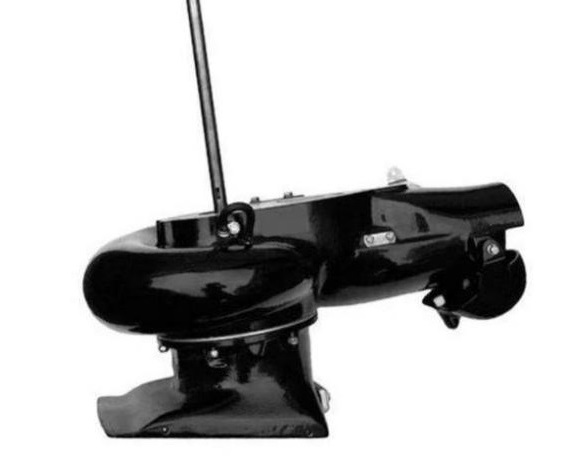
Tohatsu / Mercury 25-30HP Water Jet — when a propeller is no longer an option!
SKU: CN-YN-TO-30HP Compatibility: Tohatsu M25, M30, MFS25, MFS30 / Mercury (manufactured by Tohatsu) F25, F30 Shaft length: L — 510 mm
If you’re cruising on Latvia’s small rivers, sandy shoals, or rocky areas, sooner or later the propeller blades will remind you of it. A bent blade, a scratched shaft base, and even an engine bearing repair at some point. A jet drive solves this problem in a completely different way—by eliminating the propeller altogether and replacing it with a closed pump system that drives water through the hull.
This particular kit is designed for the popular Tohatsu and Mercury 25–30 hp engines with an L (long, 510 mm) shaft length, and it transforms a standard propeller boat into a shallow-water-capable vessel.
How a water jet works
Unlike a propeller, which “scoops” water in the open space beneath the boat, a water jet operates as a closed pump. At the bottom of the hull is an intake grille through which a rotating impeller sucks in water at high speed and ejects it through a nozzle at the stern. Instead of turning a propeller in the water, the system ejects a jet of water—hence the name.
In practical terms, this means three things:
- There is nothing under the boat that protrudes downward beyond the hull—the keel is flat
- There are no exposed rotating parts that could strike rocks or damage the propeller
- Steering is achieved by rotating the discharge nozzle, not the entire hull
Who this kit is intended for
The kit is specifically designed for the following engines:
| Manufacturer | Model | Type |
|---|---|---|
| Tohatsu | M25 | 2-stroke |
| Tohatsu | M30 | 2-stroke |
| Tohatsu | MFS25 | 4-stroke |
| Tohatsu | MFS30 | 4-stroke |
| Mercury | F25 | 4-stroke (manufactured by Tohatsu) |
| Mercury | F30 | 4-stroke (manufactured by Tohatsu) |
An important detail is the shaft length — L (510 mm). If your engine has a different shaft configuration (S — short, or XL — extra long), this kit is not suitable. Before ordering, check the letter designation on your engine’s nameplate or measure the shaft from the bottom edge of the mounting plate to the bottom of the shaft.
The Mercury F25 and F30 are listed in this kit because they are actually manufactured by Tohatsu—they are mechanically identical to the Tohatsu MFS series, simply with Mercury paint and emblems.
Key advantages
Shallow water. This is the main advantage of a water jet. While a propeller-driven boat with an L-foot needs at least 50–60 cm of depth to operate safely, a water jet works in as little as about 30 cm. This opens up access to places where other boats simply cannot go—the tributaries of the upper Daugava, the shallow sections of the Gauja, and the rapids of small rivers.
Impact resistance. Rocks, tree trunks, water plants, sand—anything that usually costs a new propeller or a propeller shaft repair is less of a problem for the water jet. The intake grille protects the impeller from larger objects, and since nothing protrudes beneath the boat, hitting a low riverbed does not automatically mean damage.
Safety for people in the water. There is no exposed propeller—therefore, there is no risk that a swimmer or water skier could get caught under the rotating blades. This is a real advantage for families with children.
Simple maintenance. Maintenance of the lower unit mainly consists of periodically pumping lubricant through the lubrication nipple. There is no need to change the gearbox oil every 50 engine hours, nor to replace the propeller shaft seals.
What to honestly say about the drawbacks
A water jet is not a universal solution, and it is important to understand this before purchasing.
Power loss is approximately 30%. This is not a figure made up for advertising—it is confirmed by both manufacturers and all practitioners. Your 30 HP Tohatsu with a water jet will effectively be around 20–22 HP on the water. This happens because the pump system is less efficient than a propeller—some of the energy is lost in accelerating the water flow through the pump.
Poor steering at low speeds. A jet ski requires water flow through the nozzle to steer. At idle or very low speeds, the steering doesn’t actually work as well as with a propeller. This takes some getting used to, especially when docking.
Reverse is limited. Reverse for a waterjet is achieved by a deflector cup that redirects the jet forward. It works, but not like a propeller’s reverse—maneuvering in reverse is slower and less precise.
Small pebbles and sand are the enemy when idling. Experienced jet ski owners emphasize one thing: do not drive slowly through shallow areas with loose bottoms. In neutral, the pump can suck in sand and small pebbles, which damage the impeller. The correct tactic is to drive quickly over shallow areas, not slowly.
Higher fuel consumption. Due to the same loss of power, a waterjet consumes more fuel than an equivalent propeller engine to reach the same speed.
Is this right for you?
Quick check:
✅ Yes, if:
- You mainly travel on rivers, especially those with rocky or variable riverbeds
- Your routes regularly include areas where the water depth is less than 50 cm
- You’ve broken more than one propeller in recent seasons
- You fish in shallow spots where other boats don’t go
- Child safety in the water is a priority
❌ Probably not, if:
- You mainly sail in the Gulf of Riga, lakes, or deeper waters
- Maximum power and fuel efficiency are important to you
- You often tow water skiers or heavy loads — a 30% loss of power will be noticeable
- You maneuver a lot in reverse (e.g., in narrow harbors)
Installation — basic principles
Installing a waterjet is not complicated, but it requires precision. Key points to pay attention to:
Raising the engine. When converting a propeller engine into a water jet, the engine must be mounted at the stern approximately 5–15 cm higher than usual. This is because the intake grille must be located directly at the bottom of the hull, not deep underwater. Many boats therefore require an adapter plate or other stern mounting.
Hull shape. The water jet works best on flat or shallow V-shaped boat hulls. Boats with a deep V-shaped hull or those with a heavy load at the stern may suffer from cavitation—air bubbles being sucked into the pump.
Initial test. After installation, check that the engine reaches the correct RPM under load. If the RPM is too low or too high, it may be necessary to adjust the impeller clearance or check the height of the intake grille.
Why this model, not another
There are several water jet options on the market—both original manufacturer kits (Tohatsu Jet, Mercury Jet) and third-party solutions. This specific kit with SKU CN-YN-TO-30HP, is designed as a suitable and cost-effective solution for owners who already have a Tohatsu or Mercury 25–30 HP engine and wish to convert it into a jet ski without purchasing a brand-new factory Jet version.
Compared to a brand-new Mercury 25 Jet engine, this conversion approach allows you to keep your existing engine and add a jet ski foot—which is significantly cheaper than buying a new jet engine from scratch.
Summary
The Tohatsu / Mercury 25-30HP L Jet Drive with a 510 mm shaft length is a specialized tool for specific needs. It won’t make your boat faster or more fuel-efficient—quite the opposite. But it will let you go places a propeller boat can’t reach at all, and do so without worrying that every rock will cost you a new propeller.
If you’re navigating rivers, shallow waters, or rocky areas—this is the right tool for the job. If that isn’t your primary use, a standard propeller will be a better solution.
Before ordering, make sure of the following:
- Your engine model matches the list exactly (M25, M30, MFS25, MFS30, F25, F30)
- The shaft length is exactly L (510 mm)—not S or XL
- Your boat’s hull is suitable for a water jet (flat or shallow V)
- You are able to properly mount the motor on the transom